
Platform for the food and beverage industry
Where manual inspection dares get bogged down in inconsistency or subjectivity, sorting machines always have the same efficient view of products thanks to cameras and/or lasers. On top of that, they help reduce labor costs, improve operational processes and even boost sales. And this is necessary because more and more customers are setting a zero tolerance regarding the presence of contaminants in products.

To optimize differentiation between "good" and "bad" products, it is important to identify the right wavelengths.
Graders can call upon different techniques (cameras or lasers) or a combination of both to inspect products from head to toe. In doing so, they can monitor different parameters: color, size, shape or even certain structural physical properties, such as chlorophyll content. It is the product to be inspected that will determine the most appropriate configuration for the grader. Still, a few basics can be distinguished that hold true for any application. The products are best conveyed in a single layer on the conveyor to the sensor. This is usually done mechanically and at the same time can already perform initial sorting in terms of size. The sensor will measure and provide the captured data to an image processing system that then controls a mechanical system or blowing system to remove the detected discrepancies from the conveyor belt. Typical applications can handle up to 25 m³ tons of product per hour.

Sorting technology has moved from a competitive advantage to a technology that is becoming a critical component in the operations of food producers.
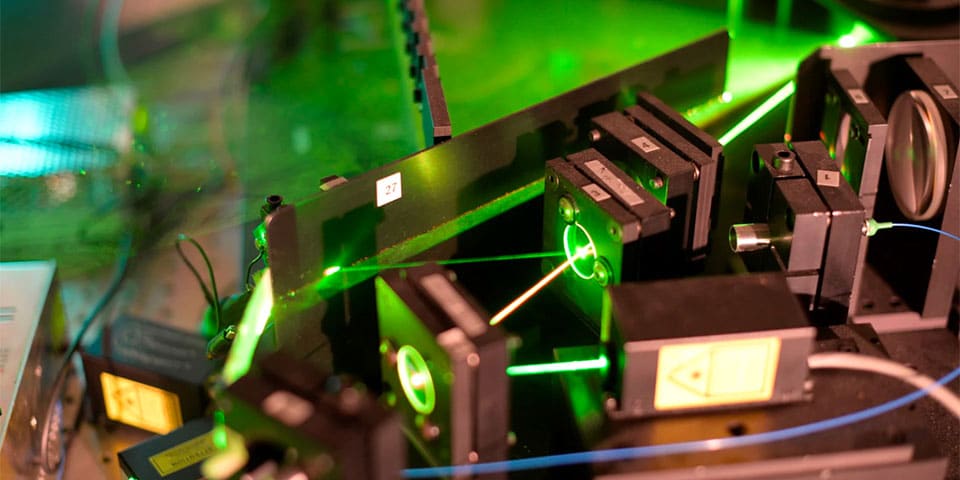
To optimize differentiation between "good" and "bad" products, it is important to identify the right wavelengths. After all, they give an object its own signature, making it easy to detect. Cameras exploit different light spectra, visible and invisible (red, green, blue, infrared or ultraviolet) to detect contaminants and defects based on color, size and shape. Lasers, on the other hand, serve primarily to penetrate the structural properties of a material. In doing so, they will reveal contaminants and certain product defects.
What they can do that cameras lack is detect the chlorophyll content of any product in a bulk stream. Testing will reveal what is the best wavelength or combination of wavelengths for your product. Modern detection systems today have tremendous capabilities. They can detect millions of subtle color differences, as well as pick out defects and contaminants of 1 mm and less. In this way, they give the food producer more control over optimal product quality.

This identifies those potatoes that have an abnormal chemical structure and an increased risk of acrylamide formation.
Depending on the application, it may be necessary to expose products from two sides to achieve the desired results. It's not just about identifying certain defects. Take peaches, for example. Graders will detect damage from insects, disease, fungus and over-ripe or unripe produce. They can also ensure that produce of exactly the same color ends up in a jar. That way, the producer does not have to fight the customer's erroneous perception that the previously yellow pieces would not be ripe causing him to leave the jars on the rack. By applying this sorting technology, sales got a big boost. And so there are still huge opportunities for producers to increase their returns.

Lasers, on the other hand, serve primarily to understand the structural properties of a material.
To make the right choice between systems, the resolution of the cameras and lasers is an important first parameter. Also consider the quality of the light. The better exposed the products are, the easier it is to sort correctly. Furthermore, the detection algorithms in the software also play an important distinguishing role. It is they who must manipulate the raw data into usable information and compare it to the limits you set. Modern sorting machines continue to evolve technologically at a rapid pace. For your production, therefore, it may be interesting to look at modular solutions that can be easily upgraded or reconfigured. Finally, as with all machine purchases, the service that the manufacturer can offer, from engineering to after sales, will be decisive.

To make the right choice between systems, the resolution of the cameras and lasers is an important first parameter.
Sorting technology has moved from a competitive advantage to a technology that is becoming a critical component in the operations of food producers. Customers are increasingly demanding the application of these techniques to achieve consistent product quality and track all incidents surrounding the presence of contaminants in the product. Can you be left behind?


