Platform for the food and beverage industry
Paper and paperboard are ideal packaging materials due to the renewable origin of cellulose fibers, high specific strength and light weight. To increase the quality and shelf life of packaged foods, the performance of paper must be adjusted via barrier coatings that provide protection against water, gas permeability or ensure retention of flavors. What about the recyclability of these coated materials: can they be reused in paper production? The project Repac2 aims to evaluate functionality and recyclability of paper for food packaging.
Packaging today plays a crucial role in the food supply by protecting quality, ensuring safety and extending the shelf life of food products. In addition to these functions, ecological impact must be considered when choosing packaging materials.
Every day, the food packaging industry is faced with choosing the most appropriate packaging material for packaging specific foods. In addition, the food and packaging industry is challenged to prove the recyclability of their packaging materials. Indeed, ambitious targets are being set at both the European and Belgian levels. European legislation requires 65 percent of all packaging waste to be recycled by 2025 and as much as 70 percent by 2030 (according to EU Directive 2018/852). At the Belgian level, the Belgian Food Industry Association (FEVIA) states that all food packaging must be recyclable, reusable or biodegradable by 2025. Recyclability is also an important feature for the realization of the transition to circular packaging.
To be applicable as food packaging, paper and paperboard materials are finished with one or more coatings that provide good sealing and barrier properties to gases and/or moisture. Currently, many coated paper and paperboard materials are marketed for food packaging applications. Traditionally, laminated plastic films are applied to the paper, but in recent years alternative coatings based on aqueous polymer dispersions have been developed. However, it is not always clear whether these coating materials meet the desired properties and are fit for purpose. However, it is generally accepted that a coating should not exceed 5 percent of the packaging to ensure recyclability. Recently, according to European recommendations, new procedures have been developed to evaluate the recyclability of coated paper and cardboard packaging materials, but they have yet to be implemented into a universal method for existing and new products.
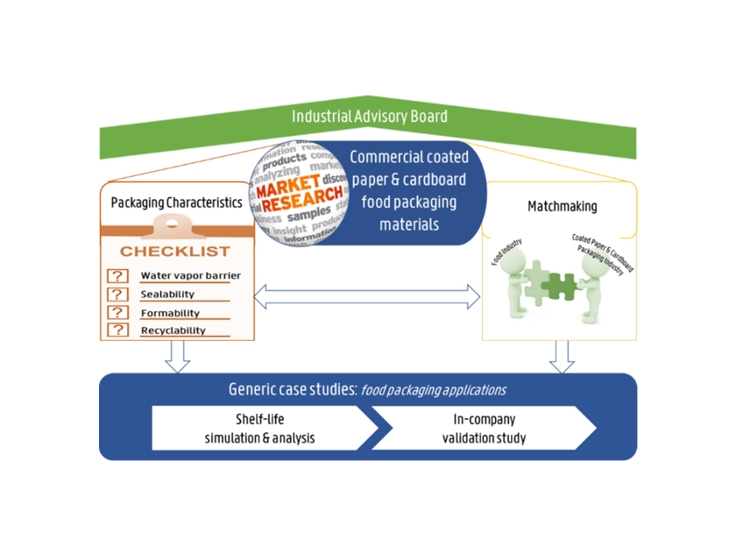
The Cornet-Tetra project REPAC² ('Functional & recyclable coated paper packaging for food products'), launched in January 2022, brings together European research partners including UHasselt, Sirris, Fraunhofer, Pack4Food, Flanders' FOOD, Natureef and West Pomeranian University of Technology. In addition, the supporting group includes some 16 Flemish companies from different sectors, including material suppliers, packaging producers and food retailers. The aim of the project is to provide support to industrial partners for an accelerated implementation of coated paper and board materials that exhibit good barrier properties in contact with food and are also recyclable according to applicable legislation. The knowledge accumulated during the project will help companies choose these materials and accelerate the possible implementation of coated recyclable materials within the food industry.
On the agenda to begin with is a market research around commercially available coated papers and paperboard for food packaging. There will be a method are being developed to determine the recyclability of coated paper and paperboard, which will be used to assess commercial packaging materials. In addition, a matchmaking event organized between food companies and the coated paper and paperboard packaging industry, which should culminate in generic case studies for further research. For these case studies, initially, a shelf life simulation tool be used, after which common shelf life studies will be implemented. Finally, in-company validation studies be set up.
Sirris, together with MPR&S, will be responsible for the inventory of existing materials: both coatings and coated materials currently on the market and in the near future. In addition, research at Sirris focuses on the recyclability of these materials according to the latest European recommendations. This will be done in Sirris' coating lab in Diepenbeek, where an experimental test line will be set up to pulverize and evaluate the quality of recovered paper fibers.
REPAC²'s target audience includes the food industry, producers and processors of coated paper and cardboard packaging, and recyclers. To increase the industrial relevance of this project, strong interaction with this target group is required.
Through a survey, we aim to obtain a broad overview of coated paper-based packaging and coatings for paper/cardboard food packaging applications that are currently commercially available or new developments expected to come to market within 1-2 years.
Participate in the survey you are not doing it for nothing! By completing the questionnaire, you are contributing to higher product awareness on an international level. The products will appear in an online inventory accessible to all and will be included in a white paper around coated paper-based packaging that will be widely distributed throughout the industry. In addition, there is a possibility that the coating or coated packaging you apply will be chosen as one of 15 materials that will be evaluated within the project in terms of functionality and recyclability. You will also have access to international matchmaking with potential end users.
The questionnaire can be found here!
This project is being implemented with financial support from VLAIO.