Platform for the food and beverage industry
Brussels Beer Project (BBP), an "urban beer brand" born in 2013, reaps the fruits of a strong collaboration with the local community and bears witness to a specific vision of life in our capital: multicultural, contemporary, vibrant and lively. Besides producing tasty beers such as Delta IPA, Grosse Bertha and Babylone, BBP also aims to be a textbook example of corporate social responsibility. The new brewery building along the canal in Anderlecht reflects the sustainable and circular company philosophy thanks to a thorough synergy between the production process and energy management. A major challenge to which the engineers involved were only too happy to sink their teeth.
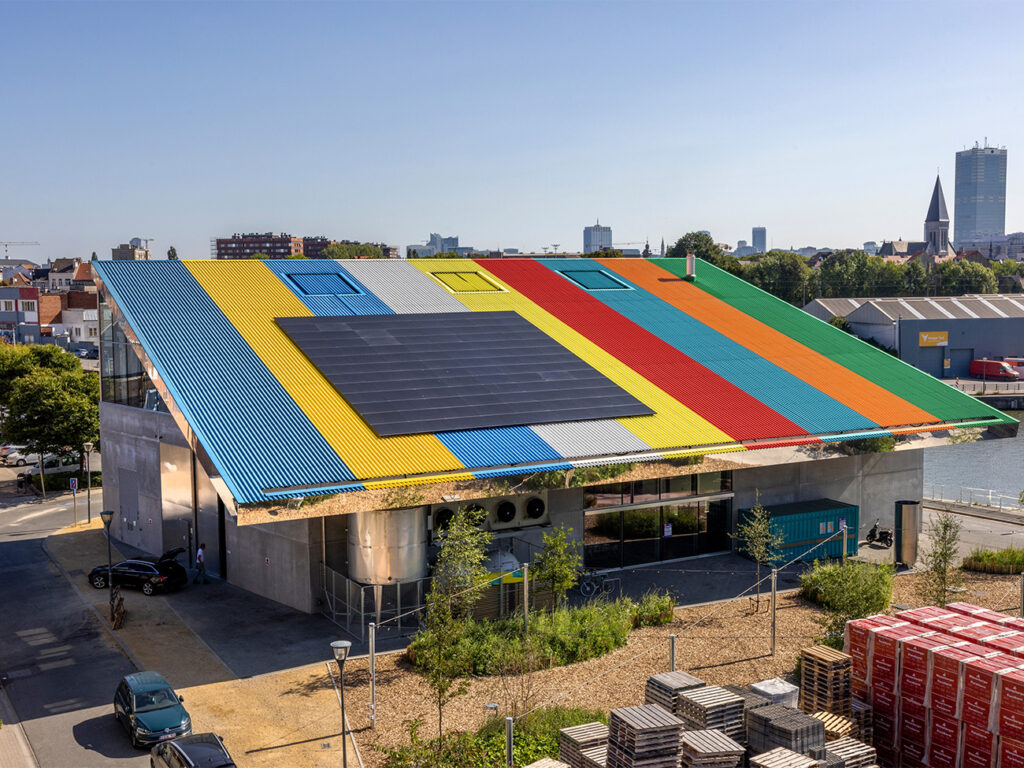
BBP's new brewery has been erected on the Biestebroek dock in the 'Haven Zuid' neighborhood. Designed by OFFICE Kersten Geers David Van Severen, the building graces the new urban landscape in the thriving Brussels canal area with its colorful roof, open layout and visible brewing equipment.

Although engineering firm Boydens Engineering already has a number of breweries to its credit, BBP's new facility was a case in point. According to Nassim Jamali, Building Performance Consultant at Boydens Engineering, "This was an industrial project in the heart of Brussels, for a client who was not used to projects of this size - it is their first large brewery building after their micro-brewery in rue Antoine Dansaert. Moreover, on the technical side, we had to take into account all the brewing techniques, which were not part of our remit. This required a lot of consultation between the brewery, the architect and our engineers."
As far as the technical concept is concerned, the main aim was to create an optimal synergy between the brewery itself - read: what it produces and the energy released in the process - and the building techniques. This is to ensure a comfortable indoor climate and maximum utilization of the available resources.
Everything starts with an architecture aimed at minimizing energy needs: optimal compactness, a high-performance exterior envelope and a good level of insulation to reduce thermal losses. Glazing is located in the north-facing facades, providing the right balance between natural light and limiting the risk of overheating in summer. According to Nassim Jamali, "During the competition phase, the orientation of the project was reversed for logistical reasons, but this did not make sense from an energy point of view. Initially, BBP underestimated the importance of renewable energy in its brewing processes. We went from a few solar panels to almost 120 (40 kW) and BBP is even considering installing more on the roof at a later stage (ideally oriented to the south)."

The brewing process generates an enormous amount of heat. Nassim Jamali: "We recover all the hot water used for brewing in a buffer tank, as well as the heat produced continuously by the cooling system, courtesy of a heat exchanger. So there is no need to additionally air condition the building, since we recover all the energy from the brewing process for heating. This enabled us to make the building carbon-neutral, although originally a gas condensing boiler was provided." The recovered rainwater is fully utilized for plumbing and irrigation. It might have been possible to go even further by integrating it into the passive cooling of the brewery equipment, but that was beyond Boydens' brief.

In a building like BBP's, consideration must also be given to the thermal comfort in the production area, which is bathed in a hot and humid atmosphere during brewing. The ventilation system was therefore oversized to provide "free cooling" at all times. It operates according to four different modes, combining whether or not a brewing process is underway with winter/summer parameters. Says Nassim Jamali, "We managed to install this huge ventilation group (25,000 m³/h) despite the constraints of size and height." The integration of technology into the architecture is also a notable feature of the project. The technical installations and brewing technologies were largely left in plain sight. Needless to say, this caused the engineers a lot of headaches in terms of coordination and follow-up, with the sloping roof as an added difficulty. On the other hand, some techniques had to be hidden at all costs, such as the extractors for the fire detection system. Boydens Engineering was also responsible for the design of the artificial lighting, which had to be adapted to the different zones (offices, tasting room, production hall ...). BBP's new brewery is about to be delivered. Although we are still waiting for the first feedback on the functioning of the techniques, we can already enjoy a good beer there, more specifically in the "Beer Garden". Or to quote BBP's slogan: 'Leave the abbey, join the playground'!