Platform for the food and beverage industry
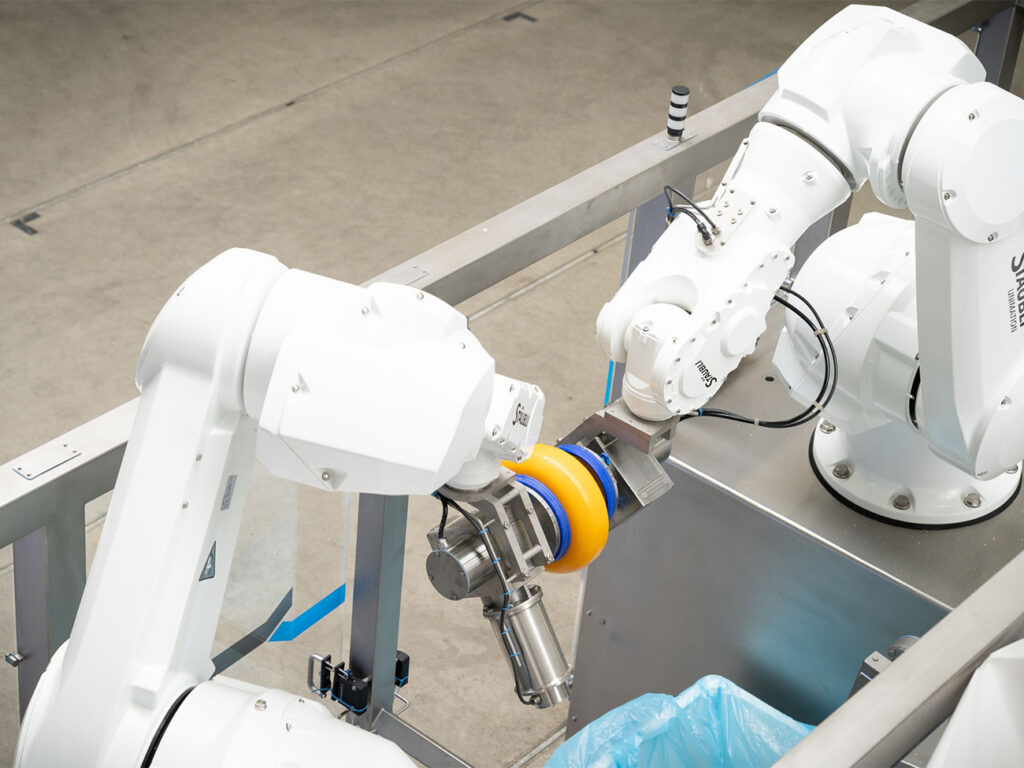
Even in the most automated factories where cheese is processed in large quantities, de-crusting natural aged cheese remains a difficult manual task. Nevertheless, it is a necessary step in production in order to cut the cheese. DERO GROUP has succeeded in automating this process now with the ELTEN/DER* 200S/2 machine. Two six-axis Stäubli robots work "hand in hand" to remove the rind in less than half a minute. A real milestone in cheese processing.
It takes about two minutes, two strong arms and an experienced worker to remove the natural rind from a round cheese. Considering that modern cheese factories process thousands of round cheeses a day, it is clear why this task requires automation. A gauntlet that DERO GROUP of the Netherlands gladly took up. Its headquarters are in Nieuw-Vennep near Amsterdam, a stone's throw from Gouda, the cheese capital of the Netherlands. With its Dero, Elten and Bosgraaf brands, the company offers automated solutions for the production, processing, handling and packaging of cheese.
Manual de-scoring is hard work, which also makes it increasingly difficult to find personnel for this job. A second reason for automating this process is the amount of waste generated, even when the cheeses are handled by the most experienced employee. Another problem is of a hygienic nature. Sales manager Joop Bouman: "Bacteria can cause ripening. Therefore, to avoid contamination, the basic rule is 'no hands on the cheese.' But it is also a natural product that varies in size, age and hardness. So the forces that must be applied can vary quite a bit."
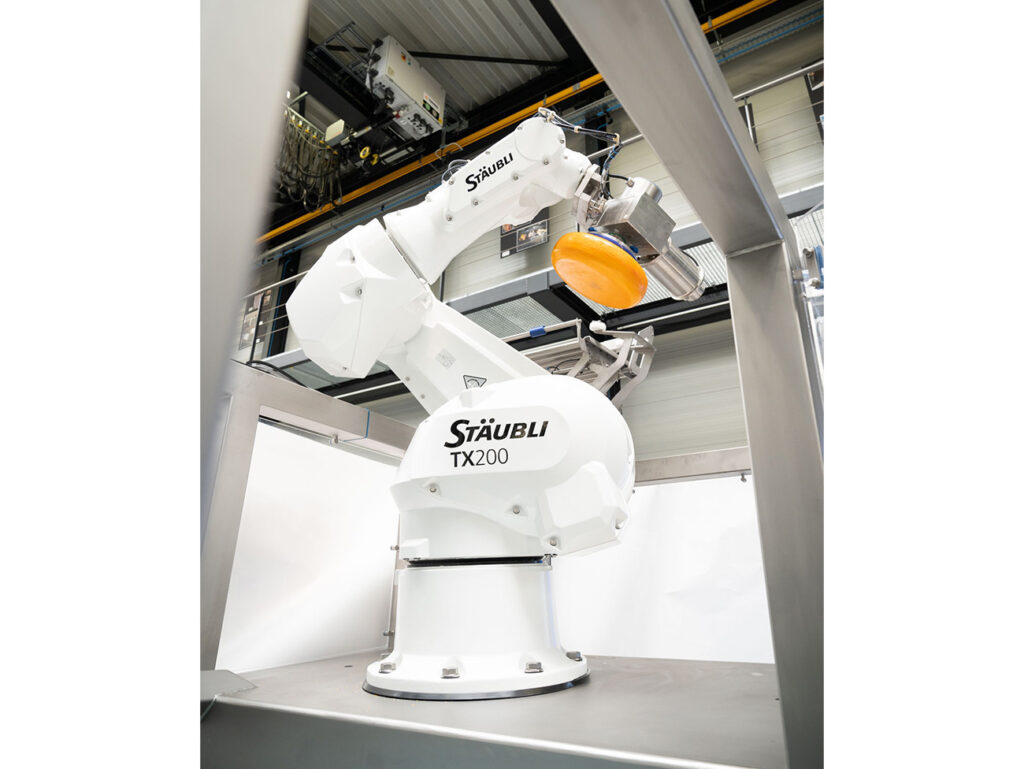
DERO developed a new machine that was able to overcome these challenges. A round cheese arrives on the conveyor belt. A Stäubli TX200 six-axis robot in HE design (suitable for humid environments and resistant to cleaning processes) for the utmost hygiene picks up the cheese with a large suction cup along the top. As the specially developed de-crusting tool is fixed, the robot performs a combined multi-axis movement, including rotation of the cheese, de-crusting exactly half of the cheese in less than 15 s. The robot then moves to a transfer position, where a second robot grasps the other side of the cheese after which the process repeats itself again. Since both robots can work simultaneously, the cycle time is about 30 s. The machine is very open and hygienic because the waste falls directly into plastic bins that can be easily removed.
In addition to speed and productivity, the machine's flexibility stands out. "Operation is very simple because we have programmed recipes tailored to the shape, type and hardness of the cheese. Whether it's six-week-old Gouda cheese or 100-week-old Edam, the robots know what to do," Bouman says. After building the first prototype in 2020, several machines have been built and sold and are running to full satisfaction. Now the derinding robots are being presented to the market. They can also be equipped with an inline vision system for monitoring the process. After processing each side, the cheese is checked by cameras. If the rind is not removed, the robot can move the cheese back to the derinding machine or to a separate reprocessing station.
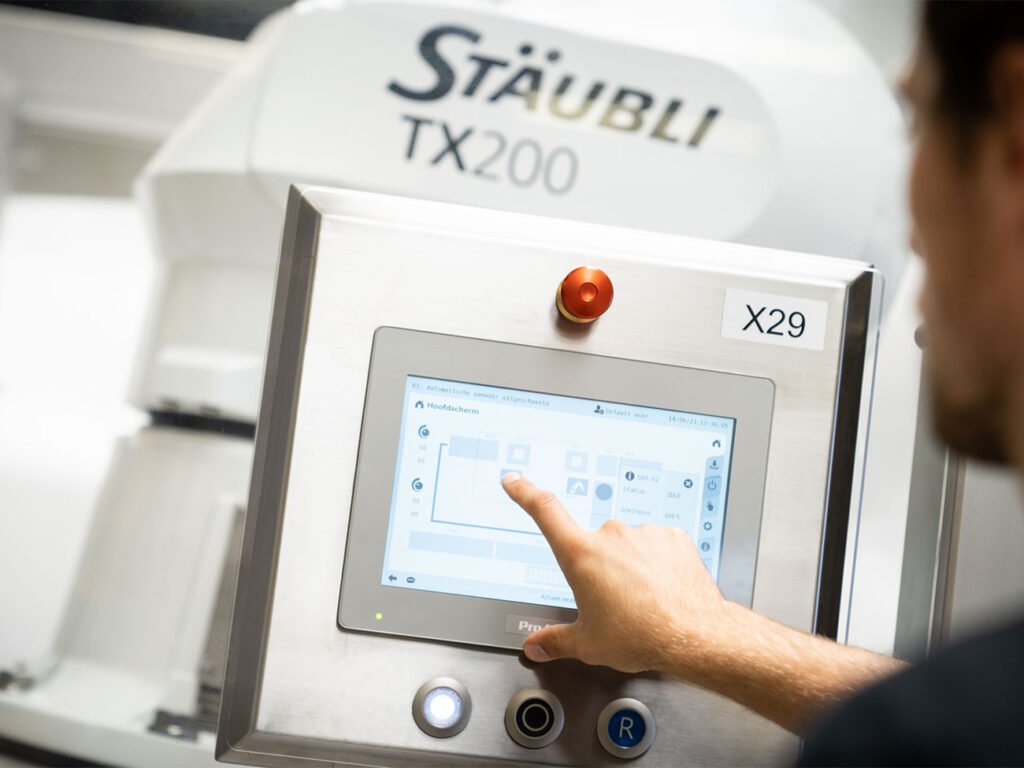
Asked about DERO's robot selection criteria, Bouman lists quite a few: "First, we often use robots from Stäubli because they meet the tough hygienic requirements of cheese processing and food production in general. In HE version, they can be cleaned every day with water or chemicals without affecting their service life." In addition, the entire Stäubli TX range offers high precision and accuracy. Programming is also simple: the entire cell is controlled only by the robot controller - no additional PLC is used. The DERO engineers chose the flagship of the TX six-axis robot series because of the reach of the arms, and because a very rigid construction is required for the contact pressure of the rotating cheese against the tool. And, of course, the massive stainless steel motor that enables the rotation of the cheese makes the arm heavier. Bouman: "The next step is a similar machine for rectangular cheese blocks."