Platform for the food and beverage industry
The demands on food producers to produce faster, longer and more with fewer errors, waste and costs will only increase in the coming years. Adding to that are the challenges associated with consumer expectations to see more product variations. This will lead to more production lines and ever faster changeovers between product batches. On top of that, the food industry is also not escaping the trend toward greater sustainability. In short, food producers must do more with less waste and cost, without sacrificing flawless product marking, labeling and coding.
Food companies must therefore scrutinize every step of their production line in search of efficiency gains, no matter how small, to improve production. After all, every incremental improvement is one step closer to full optimization. Advances in printing and coding technology now allow food producers to both meet standards and streamline operations. At Markem-Imaje, with decades of experience in direct coding, they have now been able to take a leap forward that enables efficiency gains at multiple points on the production line. "We have tremendously rewarding relationships with customers and work closely with them to understand their challenges and respond to them with products that support not only optimal printing and coding but a more efficient process in general," said Kees Bink, sales manager Benelux at Markem-Imaje.
A first step in increasing the efficiency of secondary coding is working with a vendor that has a deep understanding of the industry to provide the right advice. Bink adds, "We find that our customers can immediately gain in efficiency by switching to direct coding. There are obviously many advantages to the different approaches to indirect coding of products. But for those who want to reduce the volume of consumables and maximize their up-time, direct coding is an excellent option. And this is where we are very good at it." Building on that background, Markem-Imaje has just launched the 5940 G, Touch Dry® inkjet printer. That provides GS1-128 compliant codes, logos and text without labels and in high resolution. "Waste is not only bad for the environment but creates extra handling, work, attention and time. So a label-free solution offers several advantages. Moreover, our Touch Dry inks used with the new 5940 G contain no volatile organic compounds (VOCs). This technology is only available from Markem-Imaje - which is why it is so important as a company to match your needs with the right supplier."
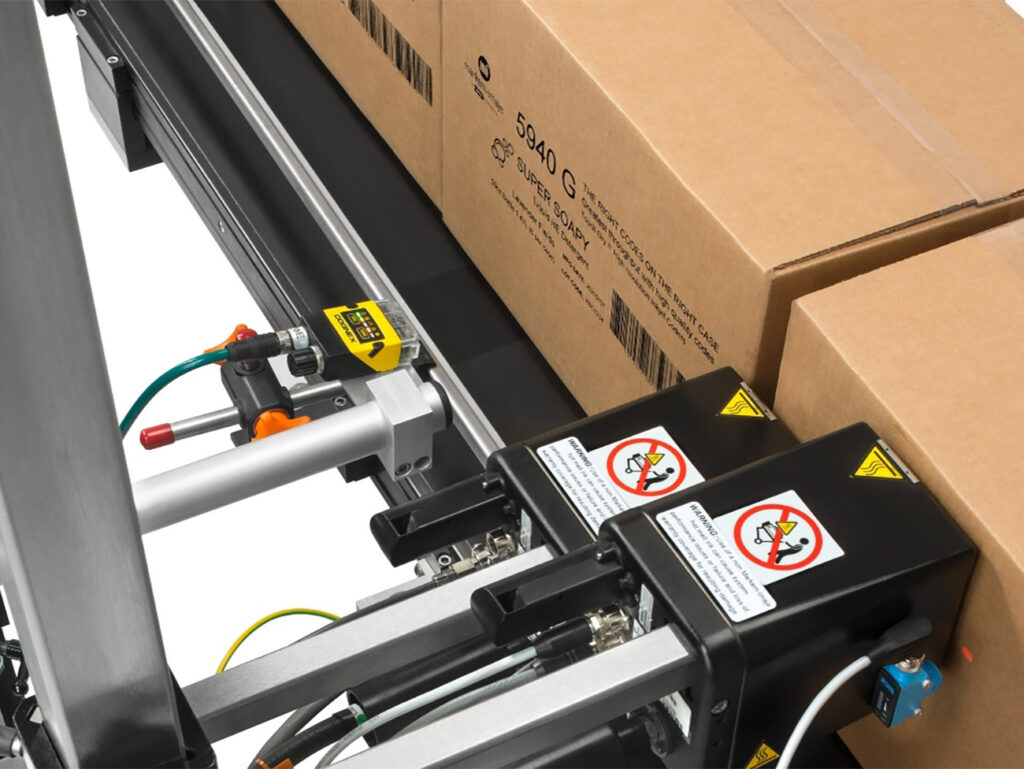
In Europe, as in most regions, the major retail chains require the provision of minimum bar codes that comply with GS1-128 Class C. When products are packed on pallets, as is often the case, coding should be provided on both sides. That way, the code is always visible and there is a fail-safe when one does not scan. Meeting these requirements increases the time and error rate on a production line. Yet smart solutions exist to keep pace with evolving industry standards. For example, Markem-Imaje's new 5940 G can be equipped with up to four printheads, allowing the two sides of a box to be printed simultaneously.
It may not be immediately obvious, but moving toward direct printing can advance efficiency in other areas. Bink explains: "We have a lot of customers who produce under private label. So they have to keep a large inventory of packaging from different brands. This takes up space and capital and also opens the door for errors. By applying secondary coding directly, uniform packaging can be used throughout the entire process." Food producers looking for a way to optimize their up-time and consumables also deserve consideration. With the Touch Dry ink for the 5940 G from Markem-Imaje, users get an ink reservoir that is 75% larger than what most competitors offer. This can reduce operator interventions by 43%. In addition, Markem-Imaje has developed the reservoirs so that they can be replaced without stopping production. "The more continuity in production, the more you can run, the more you can produce and the more profit you can make," concludes Bink.