Platform for the food and beverage industry
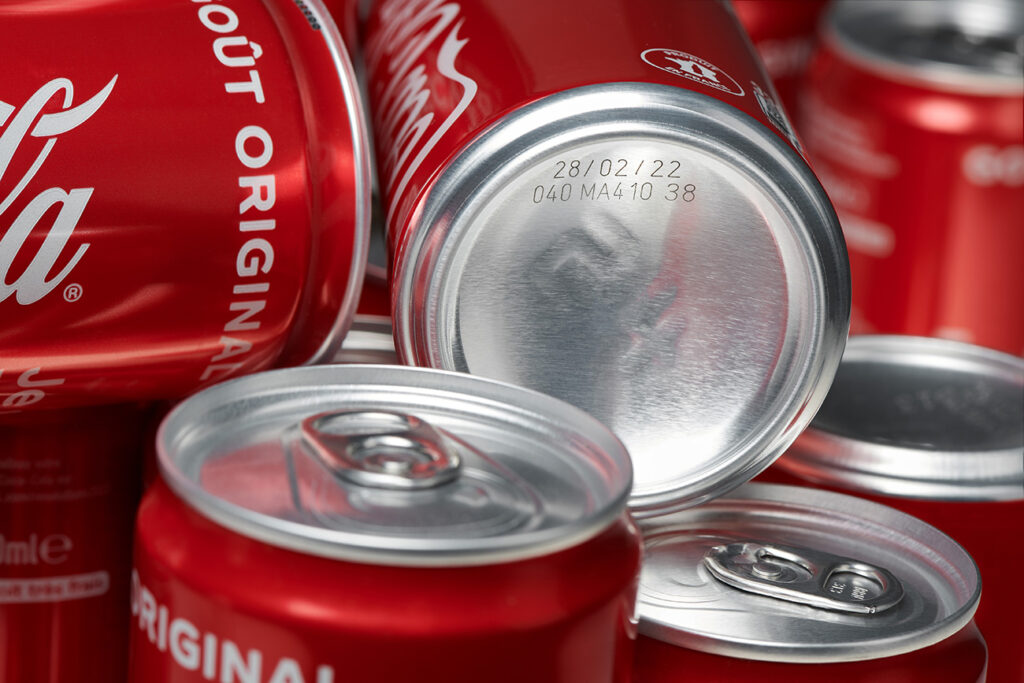
With a production rate of up to 25 cans per second, things are moving fast at Coca-Cola European Partners' (CCEP) French plant in Marseille. To ensure the quality of each finished product, the plant's marking process must keep pace with production - a challenge Markem-Imaje has met with a customized solution.

CCEP's Marseille factory opened its doors in 1970. Today, its 183 employees produce about 50 million crates of beverages there annually. Every hour, up to 120,000 aluminum cans roll off the production lines, which are among the fastest in Europe. Reliable technology is therefore a must. Until recently, the plant used inkjet printers. A technology it wanted to trade in for a more sustainable alternative: laser marking. "This switch would eliminate the possibility of releasing VOCs, and at the same time make marking more precise with better reolution," summarizes Yannick Joubert, senior manager of Plant engineering & Technology at CCEP, the main advantages. "Such systems require less maintenance. We have to change the filters annually and wipe the laser lens neatly every hour, but that's it. Before, the entire production was regularly shut down to clean the heads of the inkjet printers. And because they could get clogged, we had a dual coding system so that marking would always happen." CCEP can also save costs by no longer having to purchase ink and by not needing explosion-proof storage.
Still, the production environment was not without its challenges. CCEP Marseille's aluminum can production line is organized into two lanes that together deliver up to 25 cans per second - an exceptionally high speed in Europe. Installed at a height of about 10 m above the ground, the production line is exposed to temperatures of up to 50 °C in summer. This is double the heat that traditional marking solutions can withstand. Moreover, the production process releases aluminum dust, which is ultimately harmful to the machines unless an optimal extraction system is installed. In these difficult conditions, the bottom of each can must be marked with two lines of 18 characters. This must be done without error ... and without compromising accuracy or quality. No ordinary system can handle this task. But Markem-Imaje makes this a reality.

Markem-imaje had coding systems based on a CO2-laser for marking the PET bottles at CCEP. The fact that not a single incident had happened in all that time created enormous confidence. "Markem-Imaje was the only player who could assure us that they had a solution that could handle our production pace," Joubert adds. After consulting with the customer, Markem-Imaje replaced the four existing inkjet printers on the aluminum can production line with two SmartLase F500 fiber laser coding machines. The laser heads, pointed upward, mark the bottom of the cans at a rate of 0.004 seconds per product. The installation includes cooling units and aluminum dust extractors to protect the coding machines. CCEP chose the full package that included laser markers, accessories, equipment protection, installation training, preventive and curative maintenance and consumables (filters).

"We also greatly appreciated the responsiveness of Markem-Imaje. They made adjustments to the cooling and print signal until everything was perfectly reliable. And also the cooperation with our vision technology supplier that controls the marking process." All verifications showed that the laser technology worked without error. And although the installation is already in full swing, Markem-Imaje's teams are still adjusting the laser shielding now based on a new request from CCEP to work with their supplier to optimize the control of the markings. "We are the only ones in our group and even in the entire beverage industry to use a laser at this rate to mark cans. This achievement has already attracted the attention of our colleagues in Socx (northern France), Australia and England," Joubert concludes.