Platform for the food and beverage industry
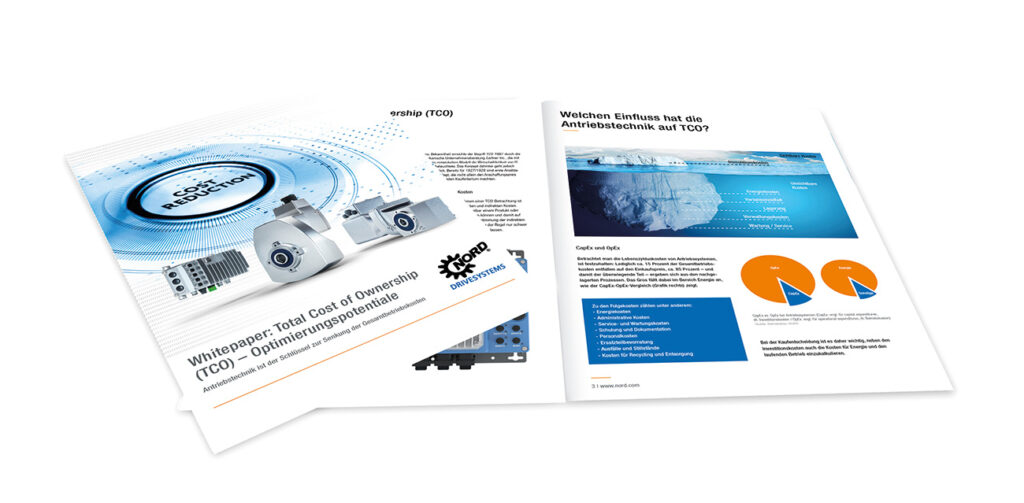
How economical can an investment be? If you look at the life cycle of propulsion systems, only 15 percent of the Total Cost of Ownership is allocated to the purchase price, while about 85 percent comes from downstream processes. Therefore, when making a purchase decision, it is important to consider not only the investment cost, but also the cost of energy and ongoing operations, i.e. administrative processes, service and maintenance, spare parts inventory or disposal.
Thus, for cost reduction and efficiency improvement in production, careful consideration of all economic aspects is essential. The concept of Total Cost of Ownership (TCO) provides support in this regard.
The two main factors for reducing TCO are energy consumption and the number of drive versions used. However, there is a conflict in objectives between energy efficiency optimization approaches on the one hand and version reduction on the other. A system with drives designed for the most energy-efficient operating point leads to optimal investment costs and motors that operate relatively economically, regardless of their efficiency class. However, the different drive versions must be managed and maintained throughout the life cycle of the system.
While a drive concept, which is primarily aimed at saving energy costs, leads to a large number of versions, version reduction is aimed at the opposite, i.e. providing the required torques and speeds in a plant with as few different drive versions as possible. Thus, while savings can be made in administration, service and storage costs, energy costs tend to increase somewhat. Therefore, it is important to reconcile these contradictions in drive design as much as possible.
Condition monitoring and predictive maintenance also play a central role in reducing TCO in Industry 4.0 applications. Periodic or continuous recording of drive and status data enables early detection of changes as well as reduction of unplanned downtime. The result: higher system availability, less downtime, lower service and material costs and longer service life.

NORD DRIVESYSTEMS takes a holistic approach to reducing the Total Cost of Ownership, using the full range of strategies to identify and increase efficiency potential: from the modular system through the use of powerful, sustainable and economical technologies, to individual TCO calculations and intelligent service and maintenance concepts.
NORD offers drive solutions to reduce life cycle costs, for example:
- with its highly efficient program (patented DuoDrive geared motor, IE5+ synchronous motor, NORDAC ON / ON+ decentralized frequency inverter)
- or with its LogiDrive solution space.