Platform for the food and beverage industry

Operating a proper allergen management system is necessary to control allergen risks. Such a system aims to provide correct product information to the consumer. The allergic consumer can then make his own safe choice based on the product information. Thus, allergen management is primarily about product and label information! And not just about preventing cross-contamination with allergens, as is often assumed. In the Operating a proper allergen management system is necessary to control allergen risks. Such a system aims to provide correct product information to the consumer. The allergic consumer can then make his own safe choice based on the product information. Thus, allergen management is primarily about product and label information! And not just about preventing cross-contamination with allergens, as is often assumed. In practice, however, we see that too little attention is paid to data management and mix-ups. Resulting in allergen recalls.
So it is important to secure all pillars of allergen management!
A good allergen plan consists of the following components:
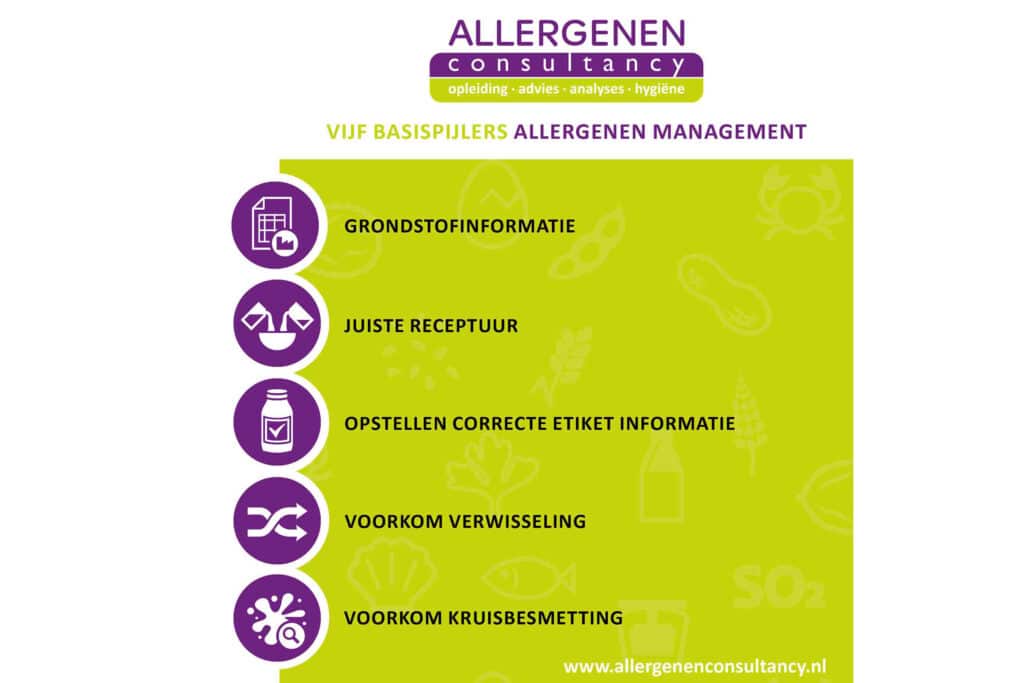
Other food safety schemes, such as FSSC 22000, BRCGS and IFS, differ among themselves properly in allergen management requirements. The BRCGS Standard for Food Safety contains the most comprehensive requirements for allergen management. Yet no scheme highlights all the basic pillars of allergen management. Often the requirements are limited to cross-contamination prevention and labeling (pillars 5 and 3).
Given the high number of allergen recalls in the Netherlands and other countries, where many companies are certified to these quality standards, this is not enough to reduce the number of recalls. And attention to the other pillars is also needed.
Codex Alimentarius has also found that the number of allergen recalls is too high and allergen management at companies needs to be improved. To this end, they have in 2020 released the “Code of Practice on Food Allergen Management for Food Business Operators” (COP). Unfortunately, it lacks the pillar of recipe management and the pillar of mix-up is also underexposed in the Codex COP. Still, this Code of Practice (COP) will help raise allergen management to a higher level worldwide.
Indeed, it is not only a guide for companies but also reason for governments to base legislation on. The release of the Codex COP prompted the European Union to issue the Hygiene Regulation adjust.
Regulation (EC) No. 852/2004, also known as the Hygiene Regulation, sets general hygiene requirements for all food establishments. Businesses are divided into the primary sector and other businesses. The primary sector includes agricultural businesses (plant and animal), fishing and hunting, but also transporters and storage companies of these products. Both in the text of the Regulation itself and in explanatory documents to it, adjustments or proposals have been made making the prevention of cross-contamination with allergens mandatory. So, unfortunately, the adaptation is very limited. But it is certainly a step towards improvement and awareness, because until now European legislation did not set explicit requirements around allergen management.
Looking for depth in allergen management or instant insight into company-specific areas for improvement? Follow the Allergen policy training in practice or leave us a AllergenScan perform. An AllergenScan provides quick insight into the status of the allergen management system.
The AllergenScan is applicable to the entire chain from raw material supplier to finished product.
Thanks to our years of experience and familiarity with common ‘pitfalls’ in allergen management systems, the AllergenScan is a fast and efficient way to set up a well-functioning allergen system. The Scan is also suitable as a supplier audit or for a thorough root cause analysis for allergen recalls.
Teach employees in manufacturing to properly handle allergens. Practical examples are used to explain what this means for daily work and how to prevent allergens from ending up in products unintentionally. The e-learning ends with a test and certificate.
The e-learning is suitable for production workers and operators working in the food industry. The e-learning is also available in the English and Polish.
The course material and test are done online, via the Internet. The average time required to complete the e-learning and take the test is approximately 30 minutes.
Neem dan rechtstreeks contact op met Allergen Consultancy.
 Contact opnemen
Allergen Consultancy has been providing allergen management support for the food industry, retailer and foodservice since 2003. With an enthusiastic team we provide advice and training. We also supply supporting products in the field of allergen management, such as rapid tests and materials for validation of cleanings Allergen management is a small but important part of the quality system. From [...]
Bekijk Bedrijfsprofiel