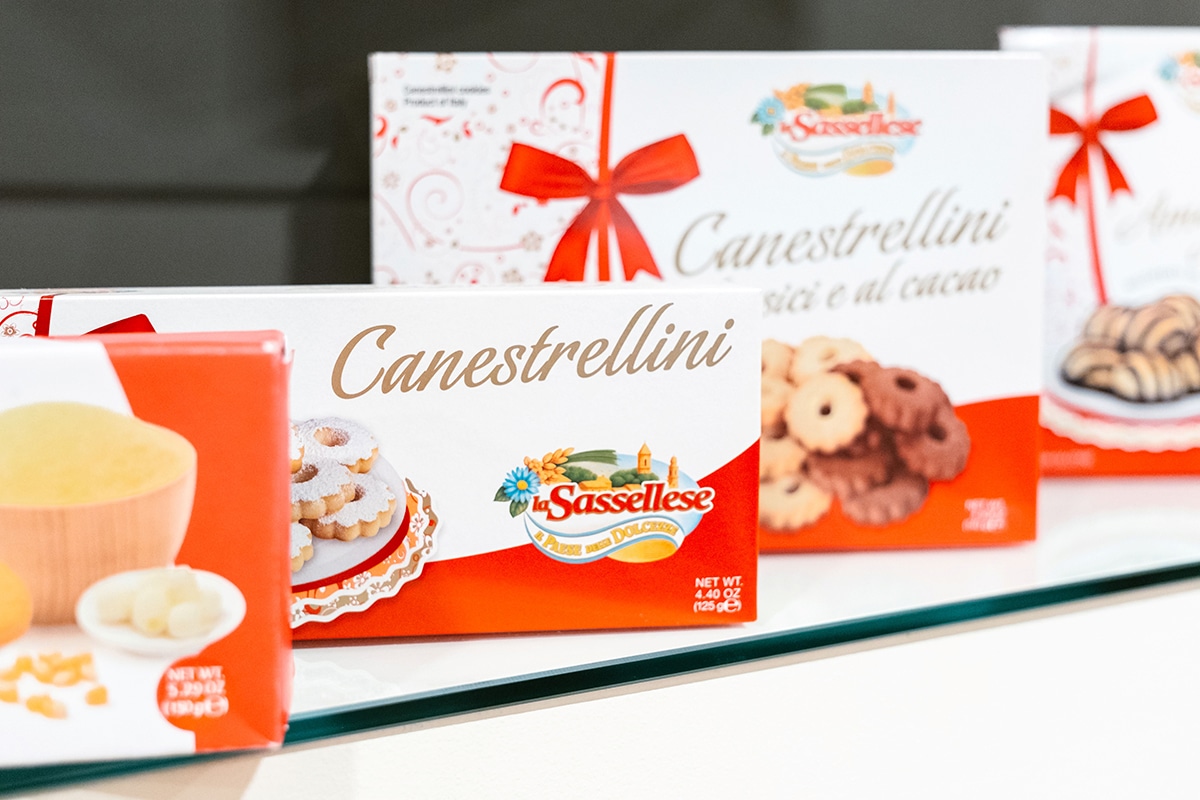
Platform for the food and beverage industry

The production and packaging of consumer goods have undergone dramatic changes over the past ten years. Despite periods of strong growth, companies have faced major challenges, such as supply chain shortages, rising costs, rapidly changing consumer preferences, and a decline in spending. According to McKinsey & Company, Americans spent 10% more on food in 2023, while purchasing 4% fewer products. What does this mean for manufacturers?
Competition is fiercer than ever, forcing companies to seize every opportunity to operate more efficiently, reduce costs, and strengthen brand loyalty. Today, digital transformation is essential for businesses that want to excel with flexible processes and healthy margins. A key driver in this transition is an updated version of the 2D barcode—the so-called Digital Link barcode—which offers new possibilities for consumer goods manufacturers.
2D barcodes are graphic codes that can store large amounts of data and make it accessible to manufacturers, retailers, and consumers. Whereas traditional 1D barcodes (UPC) contain only limited information, such as product identification and price, Digital Link barcodes can include additional data such as origin, expiration dates, and links to web pages. Although the technology has been around for decades, 2D barcodes are now gaining significant traction as an accessible entry point to product and brand information. Moreover, a major evolution is on the horizon that could place 2D barcodes at the center of interactions between brands, retailers, and consumers. GS1, the international standards organization for data, developed GS1 Digital Link, a standardized model for encoding information in a 2D barcode. Through the Sunrise 2027 program, GS1 is promoting the widespread adoption of these standards, with the goal of large-scale implementation on product packaging by 2027—from manufacturer to end user.

In a world where the demand for product and brand data continues to grow, manufacturers must evolve accordingly. While 1D barcodes were sufficient for inventory management and point-of-sale (POS) systems for many years, they no longer meet the needs of today’s complex business processes. Digital Link barcodes make it possible to create a digital twin of a product, containing information such as origin, nutritional data, production data, serial numbers, and expiration dates. These capabilities offer manufacturers new opportunities to optimize processes, make better use of data, and increase profitability. In this article, we present four strategic levers for greater efficiency.
A crucial aspect of integrating 2D barcodes is the need for collaboration across the entire organization and with external partners. Success depends on effective coordination among all internal departments and retail partners to realize the full potential. By collaborating systematically and understanding the needs throughout the entire supply chain, manufacturers can improve their operational efficiency.
Ideally, cross-functional coordination should be the starting point for every 2D barcode project, so that all parties involved share a common understanding of the objectives, opportunities, and actions. Manufacturers play a key role in this process by establishing best practices.
Key takeaway: Approach the implementation of 2D barcodes as a collaborative process. Coordinate internally and with partners to determine which data will be managed, what the retailers’ requirements are, and how the transition will be handled in practice.
The availability and quality of data are crucial for efficient production processes, but they pose a challenge for many companies. According to Hexagon, 98% of companies struggle with data issues, and 97% experience difficulties in terms of collaboration and productivity. Data comes from a variety of sources, standardization is often lacking, and 1D barcodes offer limited capabilities. This explains why manufacturers struggle to turn data into actionable insights. 2D barcodes offer a solution here, provided that the data is properly structured and managed—after all, a system is only as strong as the data it’s based on.
By storing information such as the origin of raw materials, expiration dates, inspection results, and component data, manufacturers can communicate more transparently and respond to consumer trends. Furthermore, by linking this data to ERP systems, data management can be taken to the next level.
Key takeaway: The success of 2D barcodes depends entirely on the quality of your data. Allocate sufficient resources for collecting, cleaning, and managing data.
Data management doesn’t stop at the end of the packaging line. It extends all the way to distribution and the point of sale, where traceability is crucial for food safety and supply chain security. Thanks to 2D barcodes and the greater amount of available data, systems can automatically exchange more information during scanning. By linking components to the final product, manufacturers gain a complete picture of the product’s history and can intervene more quickly when problems arise. For example, a snack manufacturer can use a scan to determine exactly which batch a product comes from, when it was packaged, and how many other products are affected. This enables targeted actions rather than having to analyze an entire production run. 2D barcodes also offer clear advantages in the event of recalls: retailers can be notified in a timely manner, sales can be halted, and consumers can access product information on their own.
Key takeaway: By tracking at both the component and product levels, you can increase efficiency, reduce errors, and minimize product loss.
Consumer demand fluctuates constantly, influenced by trends, seasonality, and changing purchasing behavior. On top of that, inaccurate data, poor forecasting, and supply chain disruptions place additional pressure on manufacturers. 2D barcodes help manufacturers gain faster insight into market dynamics and better align production with demand. By analyzing data from retail and digital channels, companies can make adjustments more quickly—whether temporary or structural. Consumer interactions via digital links also provide valuable insights.
Key takeaway: By identifying trends more quickly and responding to them, you can maintain control over your production planning and strengthen your competitive position.
The GS1 Sunrise 2027 initiatives will fundamentally change the way companies operate and offer numerous opportunities to make processes more efficient and better respond to consumer behavior. In an increasingly complex and competitive market, technologies such as 2D barcodes will help companies capitalize on new opportunities and remain successful.
Neem dan rechtstreeks contact op met Markem-Imaje NV.
 Contact opnemen
Markem-Imaje today Markem-Imaje is a trusted global manufacturer of product identification and traceability solutions. Markem-Imaje provides a full range of reliable and innovative inkjet, thermal transfer, laser, printing and labeling systems applications. Markem-Imaje offers fully integrated solutions that stand for quality and safety, comply with all legislations and requirements of retailers, thus reducing recalls [...]
Bekijk Bedrijfsprofiel