Platform for the food and beverage industry

Food companies face quite a bit of complexity in their supply chains. Where is the sweet spot between having enough inventory to serve your customers and not having too much to avoid costs and food waste? And how should you ideally plan your production based on forecasting? These are questions that traditional Excel is increasingly unable to answer. Olivier Corluy found this to be the case as well. As a supply chain specialist, he decided to develop his own software to manage this increasing complexity and turn it into efficiency gains. Since 2010, Optimact has been helping food companies find additional margins in their supply chains.
The biggest problem with Excel is that it’s not maintainable or transferable. When Corluy compiled all the data a client needed to create a smart schedule into an Excel file, it turned out that a few months later, the client could no longer work with it. “One wrong formula, one wrong cell, and before you know it, you’ve got chaos and incorrect results. An Excel file also isn’t linked to your ERP; you have to feed it data every month, and then the whole process of getting your data right starts all over again. I wanted to use software to ensure you no longer have to spend time on that—that you have immediate insight and can take action right away.”
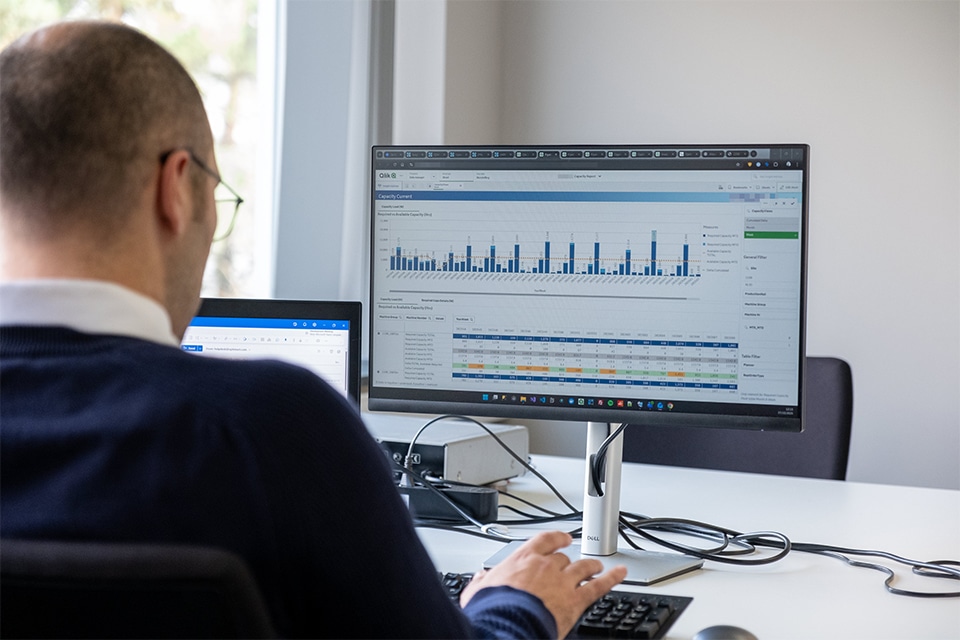
Optimact does this in four areas: it optimizes forecasting, inventory management, production planning, and procurement. Food companies can choose which modules are relevant to them. “The prerequisite is that an ERP system is in place. We then provide the interface to our software. After that, we work with our clients to identify what data is still missing to help them achieve their goals. Our role is to assess the current situation and propose improvements to perform more efficiently in the future.” Because that’s what sets Optimact apart from a traditional software vendor. The consulting aspect is just as important throughout the entire process. “It all starts with having your processes in order. But to manage your supply chains effectively, you need quite specific knowledge. That’s what we bring to the table. We want to support food companies in general—and planners in particular—as best we can. Their questions are our answers.”
In other words, Optimact doesn’t abandon its customers. “The job isn’t done once the software is implemented. Once it’s up and running, it will continue to suggest improvements. In the simulation environment, customers can also simulate for themselves what the impact of certain decisions will be.” Corluy gives the example of the Suez Canal being blocked. “Customers can then simulate what that specifically means for them—what problems will arise in their supply chain and how they can take action today.” The fact that a bit of AI is also at work behind the scenes should help make Optimact’s software even more robust in the future. “There’s no such thing as a crystal ball, but in addition to historical data, we can also factor in external variables like temperature to make better short-term forecasts or plan promotions more intelligently.”
So what does the Optimact software offer its users? “It’s becoming increasingly complex for food companies to juggle all their responsibilities. Our software helps them make their processes transparent and transferable. Even if the planner is on vacation or sick, everything continues to run smoothly. Our customers” data shows that efficiency improvements of up to 30% are possible, that forecasts improve by an average of 10 to 30%, that service levels rise, and that inventory is optimized by 10 to 30%. These are truly achievable results. It depends on where your company wants to improve and where its priorities lie. The great thing about our software is that it can grow along with our customers. And we have a strong team of specialists who are accessible and can respond quickly to provide the right answers to questions.”
Beltaste is part of the family-owned Vanreusel Snacks group. From three facilities in Belgium (Hamont-Achel), the Netherlands (Aalsmeer), and Hungary (Morahalom), it produces approximately 26,000 metric tons of frozen snacks annually. Optimact conducted a preliminary study for them. “Over the years, our processes became increasingly misaligned, but we had trouble identifying the underlying causes. That’s why we sought advice on how we could adapt and what data we needed to manage our operations more effectively,” said Luc Slenders, PMO and IT manager. Optimact discovered that a true S&OP (sales & operations planning) process was missing. “We weren’t performing badly per se, but we wanted to move away from firefighting and toward a more proactive approach. This was essential for continued growth: given the increasing complexity in the market, we would otherwise have hit our limits.” Thanks to Optimact’s consultants and software, Beltaste learned to work smarter together instead of working harder. “The data is now reliable and accurate, our planning time has been cut in half, and we’re gaining new insights from the software.”